Saturday, October 10, 2020

Debate Wrangling

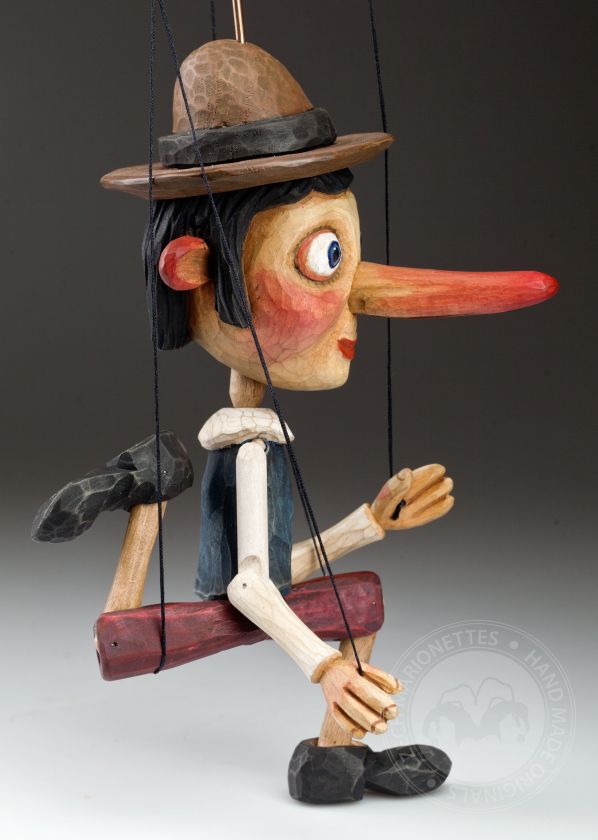
 Wooden happy Pinocchio | Marionettes.cz

Not sure how many of you imaginary readers tuned into the recent Presidential debate but, by all accounts, it was a farce. 

Lots of talking, very little information, no order. 

Many have suggested cutting the mic if a candidate disrupts the speaking format or agreed procedural flow, and that could restore some order, but wouldn't do much to elicit accurate or useful information from the debaters. 

If the Commission on Presidential Debates ever asks me to moderate, I've got my game plan ready to go. I'll open by asking each candidate to raise their right hand and swear to tell the truth, the whole truth, and nothing but the truth. This is a fantastically powerful and well-constructed phrase that deserves a little reflection.

Swearing to tell "the truth", of course, means that the candidates will accurately relay the facts about their past records, their intended policies, and their feelings. "The whole truth" means that they won't cherry pick any misleading statistics from  arcane economic reports or social studies, and present them with an intentional lack of context. And finally, "nothing but the truth" will restrict them from appending their responses with slanderous exaggerations about what will happen if the the other side's policies are enacted.

As it stands now, debate preparation is an exercise in crafting less than truthful representations of how one side is right and the other is wrong. Success is based on how effectively the truth can be bent in two-minute segments of real time. Even worse, other than next day fact checks, that seem not to resonate with any public magnitude, there is no consequence for dishonesty during the debate.  

If a citizen lies to the federal government under oath, it is a felony.  It seems to me that a candidate for a federal position lying to the citizenry is no less egregious. A sworn oath of honesty seems to work in court; I'll give it a try if they ask me to moderate.

Friday, July 31, 2020

Self-Driving Cars


Self-driving cars, you say? Bring 'em on!

Let me list a few things that I hate:
  • Bad drivers (even courteous ones)
  • Inconsiderate drivers
  • Distracted drivers
  • Bad parkers
  • Inconsiderate parkers
  • Traffic congestion
  • Traffic noise
  • Traffic pollution
  • Auto loan payments
  • Auto Insurance payments
  • Washing my car
  • People telling me to wash my car
  • Un-walkable downtowns

Let me list a few things I would love to do:
  • Sell my cars
  • Cancel my Auto Insurance
  • Convert my garage to a golf-simulator
  • Bike fearlessly through a city
  • Cue a machine to fetch me and deliver me to the doorstep of my destination
All in all, I cannot wait for self-driving cars and I expect this to happen much sooner than most of the people I speak to about it. I believe in 10 years, a drivers license will be a rare privilege, extended only to those who demonstrate an ability to drive as safely as a machine. Then what will the world look like?

There will be an 80 - 90% reduction in the total number of vehicles on the road and an equal reduction in the amount of space allocated to parking. Fewer autos, all in communication with one another, will flow smoothly across city grids, reducing commute times and eliminating parking hassles. Congestion, noise, and air pollution, along with accidents and injuries, will all decline; health and productivity of commuters will improve.

And with the conversion of my garage into a golf simulator, my handicap will dip into the single digits.

Thursday, June 25, 2020

Museum of Infamy

Jefferson Davis headed for storage.

As the arc of history lengthens, our expanding perspective on past values and behaviors reshapes current attitudes. This process of accumulating reference is continuous and slow, so slow as to be imperceptible. But social changes can happen quickly when building pressure reaches a threshold and opinions that were once widely held become untenable to a portion of the masses. 

This is happening now with the widespread toppling (or peaceful removal) of statues depicting protagonists in some of America's most obviously racist or oppressive chapters. Not everyone is happy about this and a common defense of the statues suggests they we need them to "teach history" so that it may not be repeated.

Imaginary reader Jordan Bell summarized the debate in an eloquent Facebook essay where he noted that statues may be used to "teach or educate," but their intent is to "celebrate." Given that we have many means of teaching, with statues falling low on the list of most effective methods, we should be mindful of this distinction. We need not celebrate symbols that seemed laudable at an earlier time in history, but with the benefit of reflection, we now know to be unworthy of public honor.

So like it or not, statues of historical figures who achieved popularity through acts of oppression, racism, or other unsavory deeds, are coming down. The question is, "what to do with them all?" Collectively, we are talking about thousands of works of art, all with historical significance, representing important aspects of our civil evolution, and fashioned with immense artistic skill. It is understandable why some do not wish to see these statues destroyed.

I suggest we display them in a thoughtfully curated "Museum of Infamy". 

Our state and local governments already have a great number of statues in storage (with a great number more slated for imminent arrival). They are stored and protected using tax-payer money, but are unlikely to ever again see the light of day. Collectively, they surely hold some educational value, especially if theme-based statues and artifacts could be viewed and studied with regard to a particular historical narrative. 

Perhaps such a museum could satisfy both sides of the current debate; the statues will not be glorified by public display, but will be available for viewing by those who wish to learn from them.

Wednesday, June 10, 2020

The Holden Spangler Effect


No one has really ever figured out a formula for happiness, but it has certainly been one of the most researched subjects in the history of civilized man. The evidence suggests that, among happy people, kindness, empathy, and goodwill toward others are all prevalent traits. Incidentally, wealth and fame correlate poorly with happiness.

Despite this evidence, recent generations of American parents, who presumably want their children to be happy, seem to commonly emphasize other areas of focus in their children’s development. Achievement, be it through academics, athletics, or some other pursuit, is the goal that I see most prominently encouraged. It seems as though at times, we mistakenly steer toward “success” as a less direct, but more appealing path to happiness.

Last week, my son graduated from middle school and, due to social distancing guidelines, the graduation festivities were partially virtual. The electronic portion of the event included a slide show honoring top academic performers, which is perfectly appropriate and earns my full support and respect. After all, academic rigor includes commitment, discipline, and self-discovery of one’s individual learning approach. Reinforcing and rewarding scholarship is a good thing.

However, I was more pleased that the school also gave an award to the student who most demonstrated kindness, empathy, and goodwill toward others. It is a stand-alone award named for Holden Spangler, an exceptionally kind-hearted boy who passed away before graduating from the same middle school. The award recognizes aspects of individual character that are less commonly touted, but perhaps more important in the pursuit of a happy, fulfilling life.

I am grateful to the Marco Forster Middle School for reinforcing the importance of empathy, and I am grateful to Holden Spangler for living a beautiful life. May his legacy of kindness continue to inspire goodwill toward others.  

Friday, June 5, 2020

What Happened to All the Ugly Kids?


I've got three teenagers, and they each have plenty of friends that I see on a regular basis. I also attend a great many school and community events such as dance recitals, concerts, athletic competitions, and awards ceremonies. At these events I have the chance to mingle with plenty of youths, including a large percentage of the student body at each school.

Other than during a pandemic, this pattern of activity in my life has been true for more than a decade, spanning from grade school, through middle school and high school. What always strikes me, at nearly every event that I attend, is that every last one of the kids I see is good looking. They have nice skin, straight white teeth, and attractive features. Sometimes, they even have good manners.

When I was growing up, we had some good looking kids in my school and my neighborhood, but they were the lucky few. Most were more or less unremarkable in appearance. But make no mistake, as imaginary readers from my hometown can attest, we had a hearty portion of kids who were, in the juvenile parlance of our time, ugly.

Interestingly, when saddled with unappealing physical features, I think many kids instinctively compensated for their superficial disadvantages and learned to make solid first impressions based on attractive elements of their character. I suspect that such aspects of personality would have become more or less permanent and likely have continued to serve the "ugly kids" well into adulthood.

In the end, I think most of us would prefer to be good looking if such a bestowment was both objective and choosable. But for sure, developing attractive features of character when physical good looks are not genetically transmitted, is a pretty good, if not better compensatory prize.

So, what happened to all the ugly kids? I'm not sure, but I bet a good portion of them grew up and benefitted greatly from the enduring aspects of a laudable character. After all, a polished surface will undoubtedly weather with age, but a foundation of internal beauty can last a lifetime.

Tuesday, June 2, 2020

A Straight, White, Male…


When I was working on a graduate degree in Sociology, I joked with my cohort of fellow students, all members of marginalized groups, that I was probably the only straight, white, male to ever pursue an advanced degree in a field where “inequality” is a central theme. My participation in that program shone a sometimes-harsh light on my consistent membership in the most empowered groups, at every step of my very fortunate life.

I didn’t choose to be straight, or white, or male, but like a fish that is unaware that it lives in water, I grew up oblivious to many of the subtle advantages that membership in these groups had afforded me. I was always grateful for my good health, my loving relationships, and my opportunities for education, but I was blissfully unaware of the systematic advantages that sometimes favored me more than they favored members of other groups.

I first realized these circumstances during a summer when I was offered an internship at a fairly progressive company, along with about forty other students from around the country. We were all boarded in a modern apartment complex and each paired with a roommate. Mine was a polite and soft-spoken Political Science major from Northwestern University. He was also a 6’2”, Division I football player, and he was black.

Along with a group of the other interns, he and I would often go out after work for dinner or drinks. I was flabbergasted on many occasions to observe that, in public, a great many ignorant but otherwise well-meaning people, instinctively viewed him as a threat. One time, while waiting in the lobby of a Chicago high rise in our sharpest business suits, he asked me if white women nervously clutched their purses when I entered an elevator. For dramatic effect, he had posed this question just as our elevator arrived. As we stepped in, his impact on the other passengers was unmistakably clear; two middle-aged women noted his presence, drew their purses close, and stepped subtly away. I shook my head in silent wonder as I contemplated how a lifetime of subconscious "unwelcome" signs could affect a person's attitudes and opportunities. 

On many occasions that summer, when confronted with more overt racism, my roommate and his black friends would laugh incredulously at my obvious surprise. It was the first time that I realized the palpable and enduring reality of racism in the US. They couldn't believe I hadn't noticed it before.

In the time since, I’ve thought often about what I learned that summer. It was one of the reasons that I chose to further study Sociology. But, other than making an effort to sensitize my children to subtle forms of racism, I’ve really done nothing to help. I am a white guy, silently enjoying my station, going about my daily existence, perpetually comfortable with the status quo.  In the words of the movement, I am “part of the problem”.

I don’t know the solution, but behavioral science experts agree that the first step in resolving complex problems is to “recognize” the presence of the problem. Maybe the recent unrest triggered by the murder of George Floyd will move us collectively closer to the recognition that portions of our law enforcement and justice systems harbor some long lingering biases. 

But to be clear, George Floyd is not the story. He is just the current cover of an unfinished book that opened during the era of slavery and has added a page each day since. The book depicts an epic tragedy that, hopefully, will one day climax and resolve. My question is: are we moving closer to that day, or are too many of us like fish in water, oblivious to the only environment that our empowered majority groups have ever known?

Monday, June 1, 2020

A Bird in the Hand...


I think we all know the formula, "a bird in the hand is worth two in the bush." But what is the value of "two birds on your sofa"?

I did not intend to puzzle over this today, but as you know from my recent post on mixed emotions, I have a burgeoning relationship with many of the birds that live near me. Just now, from my work space at home, I heard the familiar sound of a small feathered head banging repeatedly into a glass pane. I walked into the family room to investigate and discovered two Nightingales, closely resembling the two in the photo above, perched on my sofa. Each bore the distinct expression of a bird trying to pretend it had not just been caught in the act of eyeing my fish tank.

As I approached to open a screen and clear their path to the wild, one flew back to the kitchen and made his way outside through the sliding doors. The other, crashed into the window a couple more times, briefly hid behind the curtain, then dropped to the floor and scuttled under the sofa to hide. 

My enterprising wife, once again demonstrating her skills as a "bird-whisperer", was able to pick him up and transport him gently to the backyard where she set him free. I was greatly impressed and wished that I too could have such a close and constructive encounter with a wild animal. This of course brought the old formula to mind; was her brief episode of intimate contact, of personal interaction with nature, really only as special as an episode involving two birds in a bush?

An economist might apply the rules of resource availability and suggest that the relative scarcity of birds in the hand make them worth well more than two, relatively abundant, birds in the bush. I would concur. But I will leave the actual analysis to imaginary readers (like JD) who majored in economics and, hopefully, can derive the value of birds that sit neither in your hand nor in the bush, but on your sofa.

Friday, May 29, 2020

The Art of Concision...


"I didn't have time to write a short letter, so I wrote a long one instead."  - Mark Twain

"Everything should be made as simple as possible, but no simpler."         - Albert Einstein 

I am stuck between Twain's "too long" and Einstein's "too simple".          - Too Much Den

Next month, I will begin my 19th year as the President of a cognitive analytics company. It’s a job that has challenged the full extent of my creativity, my problem solving acumen, my sub-par diplomatic skills, and my general tendency to persevere through challenge. On the whole, I think I have earned passing grades, with one possible exception.

I am not exaggerating when I say that, on the majority of the nearly 7,000 days that I have held this job, I have devoted some portion of my day pondering how best to tell the story of what our company does. Now, I think I have at least average communication skills, and I have devoted immense effort to this problem, but somehow, I’ve not yet constructed a satisfying version of our story that is both lucid and concise.

The long version, that makes our commercial proposition clear and compelling, is too detailed and too boring for most audiences. The short version leaves most wondering what it is that we actually do. I’ve never found the middle ground that balances the two approaches.

Part of the problem is that our story is not simple. To appreciate it, one must have a smidge more than a cursory grasp of the US healthcare system, of inferential statistics, and of human cognition. However, squeezing together even a single sentence about each of these diverse and complicated topics makes for a necessarily complex plot.

I am writing this blog entry while preparing for an investor presentation and wrestling with this very problem. I am hopeful that a momentary diversion, a brief interlude with my imaginary readers, might finally shake into place the right series of thoughts, the precise words and statements that explain why our business is valuable and important.

Mark Twain implied that “time” was the key ingredient for brevity in composition, but after 18 years of trying, I’m not so sure.


Wednesday, May 27, 2020

A Brief Lesson in Grace


It was about 10pm and I was the only customer filling my tank at the station. He approached from behind the building; an older gentleman, unkempt, perhaps drunk.

Despite the potentially dangerous circumstances, he radiated a gentle vibe of harmlessness and I looked him in the eye as he neared me. I offered a smile and he predictably but politely asked me for spare change. His demeanor was proud at the core, but draped in a cloak of humility, like a capable man reluctantly seeking help with a tenuous problem. His warm expression and optimistic tone could not completely mask the undertone of desperation in his voice. Mostly, he struck me as a man genuinely in need of a break.

I handed him a twenty-dollar bill, which he beheld with what seemed like profound gratefulness, and stared back at me for a brief moment with misted eyes. He spoke no words of thanks, but I felt his deep sense of appreciation. Not appreciation for the small monetary gift, but rather, for seeing him, for trusting him, and for not deeming him worthless. He had taken my gesture as reinforcement for what he already believed about himself, and stood before me, magnificently vulnerable yet seemingly focused on a better tomorrow.

Before shuffling into the darkness, he surprised me with a hug, a heartfelt receipt for my offering. I had no doubt that, wherever he was going, he would get there eventually. Perhaps he would need some help along the way, but he was clearly intent on helping himself; a man down but not defeated, behind in the game but sure of his imminent comeback. 

As I drove home and reflected on the contrast between the current circumstances of our very different lives, I felt a pang of guilt for the near spotless record of good fortune in mine. And I realized that this chance encounter, an unexpected exchange on a random Tuesday night, was just another good break for me. I had gone out to fill my tank, and ended up as the lucky recipient of a brief lesson in grace.

Sunday, May 24, 2020

Mixed Emotions...


So I washed the windows last weekend. Upstairs and downstairs, inside and out. Took out all the screens and washed them too. Both sides. When I got everything back in place, there was a new vibrancy to every room, clean light splashed into every corner and the windows gleamed like diamonds.

As a day of physical work often does, completing the task gave me a great sense of accomplishment. Not the inspired type accomplishment where your skills or intellect were challenged and the final achievement was in doubt, but a more subdued form of accomplishment where all that was needed was commitment and perseverance. These are the more common types of achievements in life and I don't mean to belittle them; consistently "putting in the work" is a suitable foundation for an honorable life.

Since I am working from home, I've had several sunny days to enjoy the airy brightness of a home with clean windows. This has produced a steady undercurrent of joy each day. However, my positive vibe has been interrupted four times this week by the jarring confrontation between a clean window and a speeding bird.

Each of these startling occurrences left me feeling a bit guilty for my unintentional role in the collision. Though I was relieved when three of the birds got up and flew away, I have found myself thinking wistfully now and again about the one that did not.

I guess I'll just chalk this up to unintended consequences and the laws of nature. I know that dam-building beavers wreck the habitats of many lives on the nearby riverbanks and nesting squirrels chew through wires, spark fires, and burn a great many buildings to the ground each year. I cleaned my windows and felt good about it, but a few birds have paid the price for my happiness.